PORTSMOUTHPOINT

  • Subscribe to our RSS feed.
  • Twitter
  • StumbleUpon
  • Reddit
  • Facebook
  • Digg
Showing posts with label Current Affairs. Show all posts

Tuesday, September 10, 2013

A Response To "Why Abortion Should Not Remain Legal"

Posted on 4:27 AM by Unknown
by Ben Schofield

I am writing in response to the previous article, "Why Abortion Should Not Remain Legal", which I strongly oppose for reasons that I will list in detail below. I invite the writer to write and defend his position accordingly.

1. The article began with the bold claim: "Abortion is bad. This should be the start of any discussion about this sensitive issue." At the same time as calling it a sensitive issue, this statement is in itself insensitive. Rather than presenting this as the opinion it obviously is, the writer delivered it as directly as someone saying "my pen has black ink", which shuts down the debate the piece was designed to create.

2. The article notably lacked sources for any of the extreme claims it made about the bad effects of abortion. There is absolutely no evidence that having an abortion causes psychological harm. I'll say that again because it is important: there is absolutely no evidence having an abortion causes psychological harm. [Quoting Tamara Khandaker] "In 2008, the American Psychological Association formed the Task Force on Mental Health and Abortion to examine all research on the relationship between abortion and mental health and found no evidence that having a single abortion causes mental health problems. Severe mental health complications are rare, and feelings of loss and anxiety could easily be associated with whatever led the woman to get an abortion and not the abortion itself."* Correlation does not imply causality.

Continuing this point, according to the UK's Royal College of Obstetricians and Gynaecologists there is no link between induced termination and an increase in fertility**.

These two points are very important and are integral to why I oppose the previous article; it just reveals it as being poorly researched. The only places that spread this misinformation tend to be "Crisis Pregnancy Centres" set up in the appearance of legitimacy only to give misinformation to women when they are in an extremely vulnerable state.

3. It is not an article saying why abortion is bad. It is an article that begins with that premise and then goes on to say what we should be doing. By saying what we should be doing, the writer accepts that we are not currently doing it (i.e. providing enough financial care for those who can't afford a baby, or supporting women worried about their future). Surely this would then provide an argument that abortion should remain legal because we do not have these facilities, which would be taxing and impossible to run on a wide enough scale to remove these *un-cited* factors facing women. Once again, the article provides no evidence to say how many women face economic or social factors in deciding as to get an abortion, thereby negating the argument to an emotive one. There could be ten thousand cases or there could be ten. There is no point including this point if the article does not give a sense of scale.

4. What about the women who have carefully considered that they are not ready to have a child? If a woman feels unready I would argue it is perfectly within her rights to avoid the responsibility. I would also say that it is within her rights not to have to bear the responsibility for a minimum of 9 months before the baby can be adopted. The duration and difficulty of pregnancy is criminally misrepresented by those who consider adoption to be comparable as a method of getting rid of an unwanted child. (Excluding cluster headaches) labour is the greatest pain women will endure in their lives. Even before that pregnancy is a horrific responsibility which many are not mature enough to deal with, for nine months you can't drink, you must control your eating, you cannot perform simple tasks, your presence is both revered and marginalized by society, you effectively become a slave to your offspring.
 
After reading this I hope the writer of “Why Abortion Should Not Remain Legal” consider what he has written and whether he still stands by it.

*http://www.apa.org/pi/women/programs/abortion/ 
** http://www.rcog.org.uk/induced-termination-pregnancy-and-future-reproductive-outcomes-%E2%80%93-current-evidence.  
 
Read More
Posted in Blog Exclusive, Current Affairs | No comments

Why Abortion Should Not Remain Legal

Posted on 4:24 AM by Unknown
Daniel Rollins writes in response to Grace Gawn's article "Why Abortion Should Remain Legal", published previously on the blog and in Portsmouth Point magazine.


Abortion is bad. This should be the start of any discussion about this sensitive issue. However you feel about access to abortion and the personhood of a foetus, the killing of a potential human being is not something. Why then has abortion changed from a last resort for mothers whose health is in danger or are unable to look after a baby to a considered option for many pregnancies? 

The idea that abortions do, in fact, have moral or ethical weight has been suppressed in this culture. However, every so often our buried objection to the practice is exposed. The widespread objection to pro-life protesters showing pictures of the remains of aborted foetuses, insensitive though it is, is evidence that there is an ethical element to the debate, not just on the side of the mother but for the protection of the foetus. If a woman’s “right” to have sex without having to take responsibility for any babies produced is valued more than any baby’s right to exist then something is very much amiss. 

Conversely much of the opposition to the pro-life movement focuses on its apparent misogyny, favouring the life of the baby over the woman. While the mother is at least as important as the baby she is carrying, it must be recognised that an abortion is not a positive result for either. Many women suffer emotional pain or psychological harm during and after undergoing an abortion, as well as the small risk (admittedly much smaller than the risks from a “backstreet abortion” common before the practice was legalised) of complications such as infertility and haemorrhage.

The real misogyny in this debate does not come from either the pro-life or pro-choice factions but from society’s general neglect of mothers. “Pro-choicers” often illustrate their arguments with examples of young or poor women who are unable to support or raise their child or whose lives would be adversely affected by having a baby. Abortion is presented as the only ethical solution to the situation. Surely the real scandal of the situation is not that woman’s lack of access to an abortion but the fact that the woman must consider finances when weighing up a foetus’ life or that she must choose between her future and her baby’s? There must be a better way to deal with these cases, alternatives to abortion.

The only way the pro-life movement can have any credibility in this debate is by providing these alternatives. Instead of just protesting and condemning women who have abortions, they must provide practical alternatives in which both the life of the baby and the life of the mother are considered.

There are many shocking statistics that have come out of China: 500,000 people in prison without trial, thousands of executions, but perhaps the most shocking statistic of all is that 330 million abortions take place in China each year (over 900,000 per day on average). Many, if not most, of these abortions are forced, either directly by officials upholding the country’s one-child policy or indirectly by the financial burden of a second child when state support is lifted. While women in the West are thankfully freer in their decision whether to have an abortion, the concept of a financially forced abortion is still a problem for many women with low incomes. The cost of raising a baby, providing food and finding childcare may push both the mother and baby into poverty, forcing a woman to choose between feeding herself and having an abortion. The obvious way to save a woman in this situation from having to make that decision is by giving her money, funding programs that provide food and affordable housing for pregnant women and new mothers in poverty. This funding could come from either government or charity (maybe even those protesting abortion clinics), whichever corporate expression of compassion your political position prefers. Promoting adoption as an alternative to an abortion and providing women who choose to keep their baby with jobs with flexible hours and attached childcare, although difficult to provide in the currently depressed labour market, would also prevent mothers having to choose to have an abortion out of financial fears.

Another fear that can force women to make a choice about abortion is how having a baby could affect their future. When discussing this issue, several young women expressed fears about how an unplanned pregnancy would affect their future education and opportunities. Although the life of foetus may be considered more valuable than any of these opportunities, it is still a tragedy that young women who fall pregnant must choose between their future and that of their baby. Girls who become pregnant while in education should be given support by their school, college or university, which would allow them to keep studying for as long as possible and, after giving birth, they should be given further support if they choose to not give their baby up for adoption so that their education is affected as little as possible by their pregnancy. This would allow them to gain knowledge and training to find a job to support their baby and also provide them with personal opportunities to fulfil their own potential.

However the most effective way to prevent women having to make a pressured decision about abortion is through preventing unplanned pregnancy in the first place. When asked on Twitter, a feminist blogger suggested three ways to provide alternatives to abortion: combating poverty and lack of support for women; creating better awareness and use of contraception; and providing better Sex and Relationships Education (SRE). Modern contraception gives people almost complete control over their fertility, therefore better use of it should prevent many unwanted pregnancies and abortions.


This is why women (and, importantly, men too) need to take responsibility for any pregnancies both in prevention and in the case of conception, whether planned or unplanned. In the case of an unwanted pregnancy, women should not be forced into having an abortion by financial or social factors but, equally, should not use abortion as an escape from the shock of an unwanted pregnancy but take responsibility for the life inside and seek to look after the child, whether that involves giving him or her up for adoption or not. Abortions do have a negative moral weight and consequences, but they should not be needed. 

This article was originally published in Portsmouth Point Magazine, July 2013
Read More
Posted in Current Affairs | No comments

Saturday, September 7, 2013

A Warning To Voters Down Under...

Posted on 3:53 AM by Unknown
by Will Wallace

Will Tony Abbott (left) replace Kevin Rudd (right)
as Australian Prime Minister today?
(source: resources1.news.com.au)
Today, voters are being met with a choice about the future of their nation, and it is a very clear decision: change or continuity? It’s the same question that we face at every election, but for Australians, it is particularly important that they don’t make the wrong choice. Today is a turning point in that country’s history.

I’m the sort of person who loves politics - which probably makes me a bit of a loser - so much so that I have an insatiable desire to explore the current affairs of places beyond the shores of Britain. What fascinates me is where consensus and the centre-ground differ between each country: the United States is undoubtedly skewed towards being more conservative than Europe, as there are American “liberals” (Democrats) that see eye-to-eye with Dutch “conservatives” (Volkspartij voor Vrijheid en Democratie), for example. This is why a lot of people find it bizarre that my fingers are crossed for the Australian Labor Party to be re-elected next week. The leader of the Australian Liberal Party (which is nothing like the UK Liberal Democrats, but is quite conservative) is a fool named Tony Abbott. 

Why is he a fool?

(1) In 2009, he overthrew his predecessor Malcolm Turnbull, who would have made a fine Prime Minister.
(2) He doesn’t believe in climate change.
(3) He acts in his own interests, not the country’s.This third point is undoubtedly the most severe, as it is duty of elected officials to legislate and make the decisions that will benefit those that have elected them.

The last six years of Labor government in the land of Oz have seen huge strides made in the right direction: a National Broadband Network, a tax on high levels of carbon emissions, improved relations with Aboriginal Australians, record investment in schools and hospitals, the Disability Care program, the eradication of institutionalised discrimination against the LGBT community, the creation of nearly a million jobs since Labor entered government in 2007, and, perhaps most importantly, the fact that the economy bucked the global trend by not entering recession in 2008 and, instead, becoming the fastest-growing in the world. Yet, despite all the achievements, Prime Minister Kevin Rudd is set to be booted out of The Lodge (the Australian equivalent of 10 Downing St) tonight.

So what alternative does Abbott offer? 

A Liberal government will replace the NBN with an expensive and slower system, scrap the carbon tax which has reduced emissions by up to 7% in the space of a year, discontinue legislation that aims to improve Aboriginal rights, drastically cut public sector spending and oppose efforts to equalise marriage; it will put the national economy in jeopardy thanks to plans to severely reduce infrastructure investment. Unfortunately, the Murdoch-run media in Australia has played a significant hand in bolstering support for the Liberals, at Labor’s expense, and it is more than likely that the country will have a new government with a new approach and a new threat to society and the economy.

Australia, you have been warned. Brace yourselves for three years of hell.
Read More
Posted in Blog Exclusive, Current Affairs | No comments

Wednesday, August 28, 2013

50th Anniversary of The March On Washington

Posted on 12:42 PM by Unknown
Read More
Posted in Blog Exclusive, Current Affairs | No comments

Thursday, July 18, 2013

Why Abortion Should Remain Legal

Posted on 4:01 PM by Unknown
Yesterday (July 18th), Texas became the twelfth US state to pass newly restrictive abortion laws; Grace Gawn makes the case for abortion rights.

Abortion, the termination of a pregnancy, is an issue that continues to spark emotive debate as to its morality, even 46 years after it was made legal in England following the Abortion Act of 1967. Unless the mother’s life is at risk or there is danger of permanent injury to the mother or child, an abortion can only be carried out up to 24 weeks of pregnancy under current UK law. There are a number of reasons why people decide they are against abortions, for example religious belief, and those who advocate full legal protection of embryos and foetuses describe themselves as ‘pro-life’. However, despite the many arguments against it, I strongly believe that women should have the right to decide for themselves whether an abortion is right for them. There are many reasons that a woman could decide to have an abortion; alongside their physical and mental wellbeing there are many other social, economic and emotional factors to take in to account.

It is an unfortunate truth that not every woman who falls pregnant feels as though they are in the right circumstances to raise a child, be it on an emotional or financial level. The reality is that having a child will affect every aspect of a parent’s life; the dedication and time required from a parent is essential to raising a happy and healthy baby, and, if they do not have that dedication to give at a certain time in their life, then it would be unfair on both the child and the parents to disallow the option of abortion. According to a 2013 study, it costs, on average, £222,458 to raise a child, not taking in to account the commitment and sacrifices that also need to be made by any thoughtful parent. In light of these responsibilities, a mother should not be made to feel guilty about wanting to wait until she can provide a good quality of life for her child, and she should certainly not have the choice to wait taken away from her by legislation against abortion. In the words of Sister Joan Chittister, Benedictine nun and co-chair of the Global Peace Initiative of Women: “I think in many cases, your morality is deeply lacking if all you want is a child born, but not a child fed, not a child educated, not a child housed. That’s not pro-life. That’s pro-birth.”

Aside from social factors, there are many health issues that could cause a woman to seek an abortion in the best interests of all concerned. For example, the physical and mental burden of raising a child could cause a relapse in a woman with a mental disorder. Also, cancer therapies such as radiation and chemotherapy may adversely affect the growing foetus. Alcoholism can cause Foetal Alcohol Syndrome, potentially leading to deafness, speech defects (including being mute), and vision impairment. Another circumstantial case in which many women feel the option of abortion should remain available to them is after rape; if a woman falls pregnant after sexual assault it is extremely likely that she will want to terminate the pregnancy. Aside from not knowing the father’s history, mental or otherwise, the psychological damage that comes with being raped can often leave victims in a state where they would feel unable to care for a child. 

History has shown that, if abortions are made illegal, then this would not necessarily stop them from being carried out. Those that truly believe it is in their best interests to terminate a pregnancy might resort to ‘backstreet’ clinics, forcing them to break the law and in some cases undergo a potentially unsafe abortion. Legalised abortions eliminate the risk this poses and ensures that all pregnancies are terminated in a safe and clinical environment.

Many pro-life believers offer the alternative of adoption instead of abortion. However, very often part of the reason why an abortion is felt necessary is because of the unwanted physical and mental stresses that pregnancy puts on a woman’s body. Although putting a child up for adoption is a solution for those who have decided not to raise the baby when it is born, it does not change the fact that for nine months a woman will have to share her body with a foetus. Pregnancy is stressful on any woman’s body, causing morning sickness and back pains for example, and there are significant risks in carrying a child, such as hypertensive disorders of pregnancy, which are common and associated with increased risk of both adverse maternal and foetal outcomes. Pregnancy is a hard enough experience even when the mother is rewarded with a son or daughter at the end of it, let alone for them to then give away the baby. This is further complicated by psychological issues that can be caused by having to give away a child after carrying it for the full term.  Adoption can, in many cases, be as difficult a decision to make as deciding to terminate a pregnancy, and especially if the reason a woman is looking to abort is because she is not mentally ready to care for a child then she equally may not be in an emotional position to give away a child either.

Overall, I strongly believe that abortions remaining legal in the UK is in the best interest of women. For those who are against abortion, the law should not affect their lives; they are not being forced to terminate their pregnancy just because it is legal. It would be wrong to impose the views of just some people on the entire population, who are all entitled to their own beliefs. Allowing abortions legally means that those on both sides of the debate can personally choose which course of action to take upon falling pregnant; individuals are entitled to the right to decide what is best for them. Pregnancy is not always expected; as human beings we are prone to making mistakes, and methods of contraception are not 100% reliable. A woman should not be made to follow through an accidental pregnancy by being forced to have a child when she does not wish to. However, despite my belief that every woman should be able to choose to terminate a pregnancy if she wishes, I am not advocating abortion itself, but the freedom of choice. 

This article was originally published in Portsmouth Point Magazine, July 2013

Read Dan Rollins' article, "Why Abortion Should Not Remain Legal"
Read More
Posted in Current Affairs | No comments

Gay Marriage: A Victory for Progress

Posted on 12:09 PM by Unknown
Yesterday (Wednesday, 17th July), gay marriage was legalised in England and Wales after receiving Royal Assent. Here, Jo Kirby makes the case for gay marriage.  

Wednesday, 17th July was a landmark victory for progress and equality. Despite fierce opposition from many and claims that allowing equal marriage equates to supporting incest, bestiality, paedophilia and polygamy, MPs and peers voted by convincing margins to legalise same-sex marriage. 

So what had all the fuss been about? Responses from those who opposed the bill varied from outright disgust to claiming that such unions are ‘unnatural’ or ‘sinful’. As Britain's former most senior Catholic Cardinal Keith O’Brien* put it, equal marriage is “A grotesque subversion of a universally accepted human right”. However, the very nature of a human right is that it is available to all humans. Marriage is a right which should be available to everyone regardless of their gender or sexuality. The bigotry of those who oppose same-sex marriage must be challenged and exposed as hypocritical and unjust. Equal marriage is already available in 8 out of the 10 European countries surrounding Britain. This bill should not be seen as controversial but as a rational next step in implementing legislation which protects the human rights and equality of every member of our society.

Many Tory MPs and religious opponents of the bill base their case on the claim that marriage is a sacred institution. As David Simpson MP so eloquently put it “This is an ordained constitution of God. In the Garden of Eden it was… Adam and Eve. It wasn’t Adam and Steve”. Regardless of the fact that Simpson seems unaware that science has superseded mythological narratives, especially in the 150 years since Darwin, the argument that marriage is sacred seems somewhat outdated. Marriage is not owned by religion. Over 60% of marriages in the UK today are conducted in secular ceremonies. It seems that for the majority of British people the religious aspect of marriage is losing its significance. Sir Roger Gale MP opposed equal marriage for failing to protect the sanctity of marriage. He’s on his third wife.

Other MPs object to equal marriage on the grounds that it breaks tradition. However, the nature of marriage has always adapted to the times. If this was not the case, interracial marriages would be prohibited, wedlock of children would be permissible and parents could arrange the marriages of their children from birth to suit their financial needs. The exclusively heterosexual nature of marriage has not always been the tradition. More than one Roman Emperor married a man until same-sex marriages were outlawed in 342CE. Marriage has changed in the past. It is time for it to change again.

Many MPs raised particular concern over the potential for adultery in same-sex marriages. Nadine Dorries MP for example, refused to support the bill because, according to her, same-sex marriage does not require faithfulness. Mrs Dorries makes this claim despite having conducted an affair with a married man herself. Some straight people are unfaithful but we don't respond to this by banning them all from marrying. Why are LGBT (lesbian, gay, bisexual, transgendered) people any different?

One of the most incoherent arguments against same-sex marriage is that it is immoral because it does not allow for the possibility of children. Should we, therefore, ban heterosexual couples from marrying because they don't want children? Or, perhaps we should conduct fertility tests on couples after their engagement, banning anyone infertile from the opportunity to marry. Clearly this would be ridiculous. It also fails to recognise the many LGBT couples who do have children and who provide them with loving and safe homes. Same sex couples are biologically incapable of procreating with each other but so are many straight couples - this is not a good enough reason to exclude them from the right to marry.


Thankfully it now appears that such bigotry is becoming increasingly unacceptable. Bigots fail to see why partial equality is inadequate. LGBT people can already enter civil partnerships in the UK. Why do they have to fight for full marriage rights as well?

The fact is, a civil partnership is not a marriage. As Lord Tebbit declared in 2010, "We should be utterly, completely and absolutely clear that a civil partnership is not a marriage, cannot be a marriage, never will be a marriage and should be treated entirely separately from marriage." This separation clearly shows the lack of equality and perpetuates the discrimination of same-sex couples. Civil partnerships were a great step towards equality but it is time for this ideal to be fully realised.

The progress made in Parliament towards introducing equal marriage must be celebrated, not condemned. Let's not forget that marriage is about love. It creates a strong union based on commitment, stability and trust which benefits the couple, families and society. These benefits are just the same for same-sex marriages. The people who will be practically affected by this bill are couples who want to celebrate their love by having their union recognised formally. Shouldn't we welcome such commitments as beautiful and hopeful?

No one is asking religious institutions to conduct these ceremonies against their will. No one is trying to reinterpret marriage for straight people. All that is being asked is that same-sex couples who love each other and who want to spend the rest of their lives together are able to have an equal opportunity to marry. Same-sex marriage must be welcomed as progress that will strengthen the bond between same-sex couples. It will enhance, not compromise, the institution of marriage. Yes, this may seem a romanticised ideal but isn't that what marriage is all about?

* Unfortunately, there is not space here to explore the irony of Keith O’Brien’s subsequent exposure as a homosexual man unable to deal healthily with his sexuality. This resulted in his forced resignation from. Poignantly, his situation could have been so different had the equality which this bill offers been in existence when he was a young man. 


This is an updated version of an article originally published in Portsmouth Point magazine, in July 2013 and published on the blog (here) on 10th February, 2013 .

Read Simon Lemieux's article making the case against gay marriage here.
Read More
Posted in Current Affairs | No comments

Coming Out Against Gay Marriage

Posted on 11:57 AM by Unknown
Yesterday (Wednesday, 17th July), gay marriage was legalised in England and Wales after receiving Royal Assent. Here, Simon Lemieux makes the case against gay marriage. 

If you are anticipating (or dreading) a piece full of vitriol and quotes from various sacred texts condemning homosexuality, then you will be disappointed with what follows. The case I want to make against gay marriage here is not based upon any particular faith perspective nor, I hope, on unfounded prejudice. A strong and I believe persuasive argument can, I think, be made on the basis of reason, equity and democratic principles alone.

At first glance, the argument in favour of gay marriage looks persuasive and engaging. Roughly put, the case runs along the lines of the traditional argument over anti-discrimination and injustice. Like the rights of women, racial minorities and the disabled before, gay marriage is about promoting equality and opposing discrimination. But here we hit the first flaw in the argument. There is a fundamental difference between the rights of the groups just listed and the gay community. For all those in the first group, their status is imposed not chosen; the situation with sexuality is altogether more complex. There is not space here to go into a proper discussion of gay genes, and whether or not someone is ‘born gay’.  Suffice to say, there are no finite conclusions and the accepted position is to view sexuality as a sliding scale rather than a black or white distinction, and that there are a number of factors that determine one’s position on that scale. A significant proportion of it is down to environment and even choice, rather than purely accident of birth. In short, people are born male, mixed race or with disabilities in a way that they are not born straight or gay. Why does this matter? Simply because it means the debate from the start is slightly different to the ones about full equality for other groups who have been discriminated against so wrongly.

Yet by itself that is hardly a clinching argument against gay marriage. Surely discrimination even against a lifestyle choice is to be opposed? Here we enter interesting territory, and the ‘separate but equal ‘argument. The key point is that we already have ample laws that protect the rights and interests of homosexuals. There is legislative equality in areas of employment, property rights, inheritance law and, more controversially, child adoption.  A civil partnership, for example, confers equal legal rights to both partners, as marriage does to a husband and wife. Will homosexual couples be better protected legally by gay marriage? Equally, since heterosexual couples cannot enter civil partnerships, arguably it is discrimination against them to allow homosexuals alone a choice between marriage or civil partnership. In a modern liberal democracy, why not maintain different but equal categories for partnerships of intimacy? And, unlike the pre-civil rights USA, separate but equal in this case would actually be truth rather than fiction.

Yet what is it about the ancient institution of marriage that makes it so special, and best reserved for the two genders? After all, surely it has evolved and altered its nature radically over time. No longer can husbands beat their wives with impunity or even vice versa. Women no longer have to hand over all their financial resources to their husband upon marriage. Yet, crucially, although marriage, even its permanence, has evolved considerably in the last hundred years, gay marriage will do something crucial: it will fundamentally re-define it.  For centuries, civilisations have recognised the importance and value to society of having an enduring and exclusive union between one man and one woman. Its uniqueness is that it embodies and reflects the distinctiveness of men and women; therefore, removing that complementarity from the definition of marriage is to remove any widely recognised social institution where gender difference is acknowledged. The distinctiveness of marriage will be lost forever. If gay, and thus ungendered, marriage becomes legal, make no mistake, we cannot treat it as a social experiment to ’see how it works out’. The change will be permanent, the consequences everlasting. We need to be absolutely certain that this is a move for the benefit of society as a whole, and the clear will of a significant majority of the population. This leads on neatly to another point: the absence of a democratic mandate.

Marriage is an institution ‘owned’ (if that is the right word) by us all, not by politicians. Yet a pledge to introduce gay marriage was not in the manifestoes of any of the main political parties in 2010. The public consultation was largely a sham, beginning with a ‘how’ rather than ‘whether’ question, which was only changed half way through the consultation. The online response was anonymous and open to people anywhere in the world as often as they liked. The final ‘result’ of 53%-46% in favour was only achieved by ignoring half a million names who very clearly said ‘no’.  By contrast, a YouGov poll in March 2012 found 47% opposing and 43% supporting gay marriage. Even allowing for the fact that opinion polls and online consultations are not precise barometers of public opinion, I think everyone can agree there is currently no overwhelming support for this re-definition of marriage. It is arguably more about the current PM’s desperate attempt to modernise his own party’s image, and prove that it is not led by public school educated toffs out of touch with ordinary voters. The surge by UKIP (who incidentally oppose gay marriage while supporting civil partnerships) at the local elections recently, while undoubtedly part of a wider protest vote, is suggestive that Cameron’s tactic has backfired. Yet, in the end, does it really matter, can the consequences of re-defining marriage really be all that problematic? What is wrong with the ‘live and let live approach’?

Here we encounter the matter of unintended consequences. Firstly, how will those who continue to believe in traditional marriage be protected? Presumably, state funded schools will be required to teach both marriage options as part of the National Curriculum. What about teachers for whom that conflicts with their moral or religious beliefs? Will they be able to refuse to teach it or will they be forced out of a job? What about parental choice in the matter? Currently, and quite rightly, parents have the ability to have their children withdrawn from sex education and RE lessons. Will this extend to teaching about marriage and the family? Will the freedom to advocate traditional marriage be construed as a homophobic hate crime? What about council registrars who have a conscientious objections to same-sex marriage – will their rights be protected? Probably not, given that in a recent case the European Court confirmed that a public authority can force employees to act against their beliefs and sack those who resist. The case involved an Islington registrar who wished not to perform same-sex civil partnerships. The pro-gay lobby often speaks the language of liberalism, freedom and respect. The reality is that scant tolerance is shown to those who agree to disagree with them.  The dangers of an intolerant liberalism loom large. There is also the danger of sleepwalking into even more radical re-definitions of marriage. If same-sex, why not multiple unions? Sounds absurd and Daily Mail alarmist? In the Netherlands, three-way partnerships have already been given legal recognition through a ‘co-habitation’ agreement. In Mexico City, two-year fixed-term marriages have been introduced. No need for divorce, just don’t renew the marriage, a bit like a magazine or club membership description really. Yes, once the Rubicon has been crossed, don’t expect same-sex to be the final destination in the overhaul of marriage. It might well become an institution devoid of any expectations of permanence or exclusivity. Finally on this point, same-sex marriage advocates argue it will strengthen not weaken the institution. Experience in other countries suggests otherwise. In Spain, overall marriage rates fell by 20% in the six years following the introduction of same-sex marriage, and a significant fall was also reported in Holland.


There is not space in this short piece to discuss the undoubted benefits to society of our existing definition of marriage, scarred and fragile as it is, or to mention the second order issues of the proposed legislation, such as what it says about adultery and non-consummation which will enshrine inequality between opposite and same-sex marriage. In summary, though, same-sex marriage is unnecessary, unwanted by the majority and will doubtless lead to unintended consequences. Be careful of what you wish for. As they frequently say in Dragons Den, ‘I’m out!’

This article was originally published in Portsmouth Point magazine, in July 2013

Read Jo Kirby's article supporting gay marriage here.
Read More
Posted in Current Affairs | No comments

Monday, July 1, 2013

Why The World Did Not Become One Communist State Last Thursday

Posted on 4:06 PM by Unknown
by Nick Graham

On Thursday afternoon several PGS students attended a Model United Nations conference hosted by Springfield School at the Guildhall in Portsmouth. The majority of us submitted resolution that we wanted to debate within our councils. I was representing Norway on the security council, and proposed a resolution demanding North Korea disarm all its nuclear weapons.

Of the many resolutions that were submitted for debate at the Model United Nations conference at the Guildhall, there were bound to be some extreme and unbelievable ones. In this case the two most extreme ones were submitted to the security council by the Communist countries of China and North Korea, represented by Ross Watkins and Will Bates respectively.

China submitted a resolution recommending the creation of one-world state that would be run under a communist system in order to promote equality around the world.  His themes of worldwide equality and equal representation of for each of the former states, received mixed views. Some of the larger nations such as the USA were reluctant to give up their power, while some  of the smaller states liked the ideas. However, many states were concerned about how this equality would be ensured. The real deal-breaker for many countries was the article recommending that this world state should run on a Communist system. It was this that dissuaded the vast majority of the nations involved.

Although Ross was extremely persuasive, he had to deal with stiff opposition, especially from Tim Bustin, who was representing Germany. Ross had one loyal ally throughout - Will Bates as North Korea. Will’s way of supporting this resolution was to give passionate anti-American and anti-Western speeches. The words ‘imperialist, capitalist Westerners’ often featured in these speeches. A successful amendment removed the clause that stated it would be a Communist state, and soon afterwards the resolution itself failed, with only two countries voting for it - China and North Korea.

The other Communist resolution was even more controversial - that all countries should have the right to buy and sell nuclear weapons. It also included two anti-American clauses, which gave greater influence to North Korea’s allies,  and demanded that the USA must disarm first before it forced anyone else to. The Western nations, including the USA, violently objected at first.  The USA and its personal allies were particularly incensed. Again there were passionate speeches for the resolution by China and North Korea, and yet again firm opposition by Germany. Even though this resolution was seen by many as provocative, many states who did not have nuclear weapons voted in favour of it, and the resolution only failed by one vote!

The last event of the afternoon was the emergency debate. The news was that chemical weapons had been used on refugees leaving Syria and in refugee camps over the border. This caused a lengthy and passionate debate about who was to blame. Yet again North Korea made an anti-American speech claiming that they had orchestrated it to take the oil resources in the region. Turkey mobilised its armed forces and my resolution to mobilise UN forces to help protect the refugees and prepare for a counter-attack against Syria passed.

Although there was no-one representing Syria at the conference, they had limited support from countries including North Korea and Australia. North Korea claimed that it was the rebels who were in the wrong and that military support should be sent to the government, while countries such as Germany and Australia said that we should wait until we know who was responsible before declaring war or action against any one group. However, in the end the status was that Turkey had prepared for an invasion of Syria and UN forces were ready to help with this war. Several UN sanctions placed on Syria as well. As the debate ended, there was an attempt by Will Bates to declare war on the USA and their allies due to their preparations for war against the Syrian government. This however was swiftly refused by Will Wallace as the chair, much to everyone’s amusement.

Overall, the entire afternoon was a great success and enjoyable for everyone involved, including the Chinese and North Korean delegates (despite their defeats). We thank Springfield School for so kindly inviting us and for running the conference so hospitably; we are all looking forward to a repeat of this next year.


Read More
Posted in Blog Exclusive, Current Affairs, MUN | No comments

Wednesday, June 19, 2013

Following the Boston Marathon Bombings, Are New Internet Laws Required?

Posted on 11:20 PM by Unknown
by Charlie Henderson

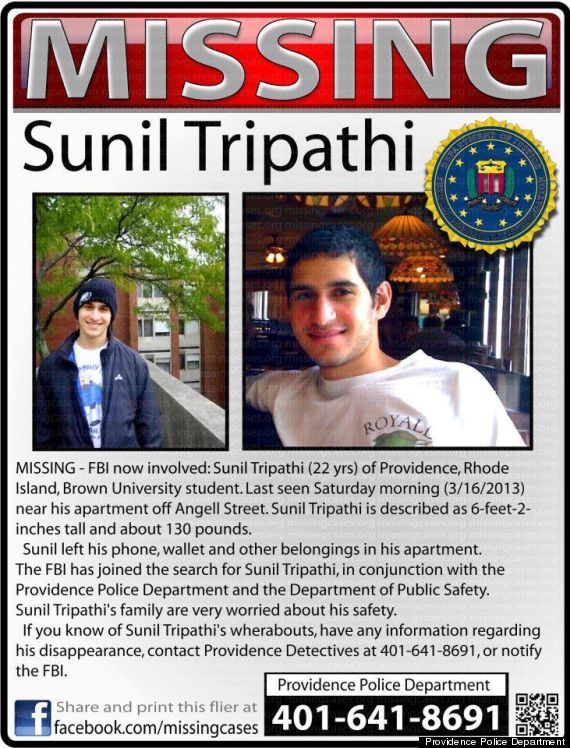
Innocent: Sunil Tripathi
(source: Huffington Post)
As many of you probably know, on April 15th two bombs were set off near the finish line of the Boston Marathon in the city’s centre, killing 3 people, including an eight year old boy and injuring 264 more. What followed was one of the largest man-hunts in US history, which culminated in a shoot-out between the two suspects (Dzhokhar and Tamerlan Tsarnaev) and law enforcement, in which Tamerlan was killed and Dzhokhar was injured, along with 16 police officers.
During the man-hunt, users of social media websites such as Twitter and Reddit were encouraged to trawl through the publically available CCTV images of the marathon to try to identify the perpetrators of the bombings. This ‘crowd sourcing’ made apparent the huge power social media holds. When a thread on Reddit made a comparison between a photo of a suspect (who was later identified as Dzhokhar) and the missing 22 year old student Sunil Tripathi, an online witch hunt was started which led to Tripathi's family home being surrounded by news vans and the Facebook page set up to help find him being bombarded by hate messages. During an interview with BBC World Service, Sunni’s sister, Sangeeta Tripathi, said "Our entire neighbourhood and our house were surrounded by media trucks. On my personal cell phone I got 72 phone calls between 3am and 4.30 in the morning.” The only evidence that the online sleuths had that Tripathi was the bomber was that he looked similar to one of the suspects and that he had been missing since mid-March. Sunil Tripathi’s body was found on the 23rd April, 2013; it is thought that he died before the bombings took place.
In the past, man-hunts were the domain of the police and the public’s only sources of information were tightly controlled newspapers and official wanted posters. Now so called ‘internet sleuths’ can become pseudo-policemen from thousands of miles away, which, in the case of Sunil Tripathi, had disastrous consequences.
Although the framing of innocent people online causes great distress for them and their families, there is a much more serious effect that is not immediately obvious. The FBI (the American equivalent of MI5) reportedly identified the Tsarnaev brothers early in their investigations, but were keen not release there photos until after they had been apprehended, as this would give them warning that they had been identified. When the FBI became aware of the online man hunt on the 18th of April, they released photos of the Tsarnaev brothers. The FBI released the photos to protect the victims of the online vigilantes and their families. Barely hours after the photos were released, the brothers shot and killed a policeman on the campus of one of America’s top universities, MIT; it is thought that they carried out the shooting so soon after the bombings as a result of their identities being released, in a desperate last attempt to have as big an impact as possible, meaning that, perhaps, the online vigilantes did more harm than good.
This presents a new problem for the governments of the world; to prevent a repeat of the Tripathi case they would have to impose strict laws preventing people speculating online on who committed something; or they do nothing and risk a repeat of this case, resulting in avoidable fatalities. Following the recent surveillance scandal that has rocked the US and its allies over the last fortnight, it is unlikely that the necessary legislation will be introduced in any of these countries. We have reached a crisis point, where we must choose between security (thus introducing new laws restricting internet traffic in the wake of attacks) and privacy (where we do nothing and risk even more people being harassed and more criminal investigations being seriously hindered).
Read More
Posted in Blog Exclusive, Current Affairs | No comments

Saturday, June 15, 2013

Why The US Supreme Court Has Made The Right Decision Regarding Gene Patenting

Posted on 4:46 AM by Unknown
by Tim Bustin

(source: biopoliticaltimes.org)
On Thursday, the US Supreme Court ruled that human genes may not be patented, as “a naturally occurring DNA segment is a product of nature and not patent eligible merely because it has been isolated”. It would seem obvious that the human genome is not something that any person, firm or university could ever claim to have invented, yet the past three decades have seen enormous controversy over patents being granted for the discovery of parts of the genome, leading to a monopoly over the research and application of potential uses for the patent holder; research that, with certain genes, desperately needs to be undertaken, in order for diagnostic testing to occur, which could prevent or cure genetic diseases, such as some cancers caused by (until recently) patented genes.

What is confusing about the whole issue is that the Supreme Court has never come to this conclusion before, regarding gene patenting. Unfortunately the final ruling is still more of a compromise, as synthetically created versions of genetic material are still eligible to be patented. Overall it seems to be astonishing that, despite years of calls for the courts to realise that the law was being followed inaccurately and immorally, that they have only done something about it now.

Only now are the dangers seemingly being appreciated. Author Michael Crichton (of Jurassic Park fame) writes in Next (the last book before his death in 2008) how genes are “facts of nature… the patent consists of pure information” so patenting of them is as ridiculous as “allowing somebody to patent noses” a patent which would’ve stopped the invention of “Kleenex, nasal sprays, masks, make-up and perfume”; would not allow you to put sun cream on your nose, as this is a modification of the nose, and so on. A gene patent leads to an all-out ban on everything to do with the gene; completely different from the vast majority of granted patents. Despite the absurdity, it’s obvious now that common sense is finally prevailing and that the first steps of altering the laws and establishing clearer guidelines are being taken at last. Whether this will eventually stop research being effectively banned, or other of Crichton’s views such as gene testing data being made public and human tissue remaining your property after being removed from your body, is certainly unclear.
Read More
Posted in Blog Exclusive, Current Affairs, Science and Tech | No comments

Monday, June 10, 2013

The Legacy of Margaret Thatcher and the Future of British Conservatism: A Debate

Posted on 8:07 AM by Unknown
Acknowledging supporters, 1983
(source: BBC)
Yesterday (June 9th) was the 30th anniversary of Margaret Thatcher's landslide re-election in 1983, which inaugurated the most radical stage of her premiership. PGS MUN marked this event with a debate: "This House believes that Margaret Thatcher has proven a millstone for the current Conservative Party", expertly chaired by Mr Lemieux, with Will Wallace supporting the motion and Mr Doyle opposing it. The debate prompted a sizeable audience, showing just how much interest and controversy Margaret Thatcher still attracts nearly a third of a century after her most significant electoral victory.

Will Wallace began by pointing out that he is a Conservative Party member and activist, that he agrees with much of her ideology, but that her legacy causes much of the current strife within the party and is a political hindrance. He argued that in 1975, just before she became Conservative leader, there were still many Conservative seats in the north of England (much reduced in number by the 1990s) and that the gap between rich and poor was narrower than it was when she left office in 1990. He noted that unemployment was 5.3% in 1979, but 11.9% by 1984. He agreed with her free market ideology but felt that it was taken too far and became too divisive, that, although her council home sale policy helped attract working class voters in the short term, in the long term the working class (particularly in the North) abandoned the Tory party. While many of her privatisation policies made sense, they went too far when she threatened popular and essential public services. In summation, Will argued that to attract the centre ground and to reflect the early twenty-first century, the Conservative Party needed to abandon Thatcher's 1980s approach, however valuable it may have been then.

 Mr Doyle replied that her legacy was the economic progress that the country had made during the 34 years since she was first elected Prime Minister. Only a handful of world leaders, and no British leaders, have had an "-ism" added to their name, Thatcherism denoting a belief in the free market and a small state, with government getting out of the way. Major and Cameron had both failed, which was not Thatcher's fault. He argued that her re-election in 1983 heralded her period of greatest reform between 1984 and 1987, finally ridding Britain of its image as the "sick man of Europe"; he contrasted her effective use of large majorities with the Blair government's failure to use even larger majorities in the 1990s to achieve lasting change. By the end of her time in office, he said, unemployment was down to 2 million and has not been reduced any further since then (due to the mistakes of her successors). She had no choice but to take the measures she did, in the face of the stranglehold of the trade unions that broke the Heath and Callaghan governments in the 1970s. However, she was not only significant in terms of her economic policies (resulting in lower taxes, higher productivity and a reduction of strike action) but was also a transcendent cultural figure, a self-described "conviction politician" with the aim of making Britain a better place, not worried by pollsters or image. She led her Cabinet from the front.

From the audience, Henry Cunnison argued that a major cause of the current economic crisis was the reduction of regulation in the City, a process begun under the Thatcher government. Mr Doyle responded that this was the result of Labour's policy of making the Bank of England independent. Mr Lemieux asked whether, if Mrs Thatcher had been in power in 2008, she would have taken different action to that of the Brown Government. Mr Doyle's view was that it was difficult to answer "what-if" questions, but that, had Thatcher not left office in 1990, the Bank would not have been given independence and supervision of the City would have been tighter, reducing the impact of the Crash in 2007. He also argued that, unlike contemporary politicians, Mrs Thatcher had principles. Later in the debate, Neil Chhabda asked whether deregulation had gone too far, Mr Lemieux supplementing his question by asking whether it had left the economy slightly unbalanced with too great an emphasis on the financial sector.

Will Wallace suggested that Mrs Thatcher would have been too ideologically dogmatic to respond effectively to the crisis, that this same rigidity was manifest in her decision to impose the Poll Tax in the late 1980s, punishing the poorest the most, which showed she did not understand working people. He countered arguments that contemporary politicians had no principles by arguing that David Cameron supported gay marriage in the teeth of opposition from his own party. Mr Lemieux wondered whether both Thatcher and Cameron, with poll tax and gay marriage respectively, had miscalculated: Thatcher with the wider electorate, Cameron with his own party members. Will argued that it was a mistake to go to the right and to abandon mainstream voters, which would lead to defeat in 2015.


Douglas Mileham said that leaders needed a goal or risk getting bogged down. Will said that Thatcherite goals would be actively harmful for the current Conservative Party. Mr Doyle said the difference was that Thatcher alienated her Cabinet but kept the loyalty of party members, whereas, with Cameron, it was the other way around, that there was no hope of winning North or South if the activists were demoralised.

Ross Watkins argued that Mr Thatcher's industrial policies in the North were still a political millstone in that region thirty years later. Mr Doyle replied that the coal mines were economically unviable, but agreed with Ross that Thatcher could, in some industrial areas, have taken a slower approach that softened the social impact on local communities. However, he noted that the NUM leaders had been spoiling for a fight and that they had brought down one government already in the 1970s.

Charlie Scutts questioned whether Thatcher had really had a negative effect on working people. Will said that her legacy had been a widened gap between rich and poor, while Mr Doyle said that she understood working class aspiration as she had herself risen from the lower middle class. William Bates asked why the Conservative Party now had only 150,000 members in contrast to 1,000,000 in the 1980s. Will said all parties were losing members (with the exception of UKIP), that people were less frequently voting by social class and more voting on single issues. Mr Doyle felt that, whereas in the 1980s, there had been clear political differences between the political parties, now they were all focused on the centre ground, treating voters as if they did not have minds of their own. Mr Lemieux asked whether you could not be moderate and have a political backbone at the same time. Mr Doyle said that moderation was one thing, but being poll-obsessed was another.


Rob Bendell asked Will how he could call Cameron a principled politician when Cameron had referred to himself as "heir to Blair". Will said Blair had been in the wrong party and was actually a Tory; furthermore, Cameron was showing his principles by facing down those members of the party allegedly referred to in certain quarters as "swivel-eyed loonies". He said that there were reactionaries among both Conservatives and Labour who threatened to hold their parties back. Mr Doyle counted 19 U turns by the Cameron government within the first few months in office; furthermore, he argued that Cameron's position on gay marriage was opportunism rather than principle, an attempt to "detoxify" the Tory image. Mr Lemieux said that Thatcher had been a more consultative Prime Minister during her first government, but less so after the Falklands War. Mr Doyle felt that this was because, from 1983, the Cabinet reflected her own choice rather than that of her predecessor.

Tom Harper felt that the future of the Conservative Party was Thatcherite and that Will was swimming against the tide. Will felt that, although her policies had been necessary in the 1980s to create a strong, prosperous economy, society had been left less united because of her tearing up the social fabric. Mr Doyle countered that the nation had been disunited in the 1960s and 1970s, so this was nothing new. Ross Watkins suggested that the poll tax had helped fuel Scottish nationalism and Mr Doyle responded that this was only one issue influencing the rise of nationalism in the 1990s and early 21st century.

In conclusion, Mr Doyle argued that (pointing to the audience) "You are her legacy, which is all for the good." He noted that Margaret Thatcher called herself a conservative, yet led the most radical government in living memory. Summing up, Will responded that the country needed a change of direction in 1979 and that Thatcher was the much-needed agent of that change. However, her legacy included a severe increase in the gap between rich and poor which remains with us today and, moving forward, we need a change from thos policies in 2013.

The final vote was 8 in support of the motion, 20 against and the remainded abstaining, suggesting that, 30 years after her most significant victory, Thatcher is still seen as an asset for the contemporary Conservative Party.


Left to Right: Mr Doyle, Mr Lemieux and William Wallace

All pictures copyright Daniel Rollins 2013 used with permission.

Read More
Posted in Blog Exclusive, Current Affairs | No comments

Wednesday, April 17, 2013

Jokes: Where is the Line?

Posted on 1:24 AM by Unknown
by Oli Price


Frankie Boyle
(source: Wiki Commons)
When I realised my blog article was due I was frantically searching for a topic or issue to write upon, then on my internet homepage I saw the breaking news that former Prime-Minister Margaret Thatcher had died. Within minutes the web was ablaze with debates about her prowess during her time in Government, also due to the advanced technology of the times in which we live and due to the divisive nature of Baroness Thatcher, there were immediately internet jokes or “memes” popping up about her demise. Usually when there are reports of these jokers saying outlandish comments on a sensitive issue the culprits are usually attention-seeking teenagers who don’t realise the gravity of their words. However, in this instance I saw adults poking fun and criticising Thatcher; even celebrities wanted to voice their opinions, no doubt against the advice of their publicists and managers. Unsurprisingly one man’s name was prominent amongst those “internet trolls”, that man is Frankie Boyle. Don’t get me wrong this article isn’t an attack on the man, I actually find him quite funny; however, I think it will be interesting to look at the question of when the line is crossed and something goes from being funny and tongue-in-cheek to being offensive and crass.
There are a couple of examples of comedians who sail fairly close to the wind, a poignant one being Ricky Gervais’s series Extras. This series was seen as controversial due to famous celebrities playing a distorted parody of themselves for comic effect, for example Keith Chegwin portraying himself as a dim-witted homophobe or Sir Patrick Stewart playing a creepy, lecherous version of himself. During one scene in the third episode of the first series, Gervais’s character jokingly questions whether a character with cerebral palsy is drunk in order to impress a female cast member, only for her to tell Gervais’s character that the girl is her sister. Despite this possibly being seen as offensive, the gag works because the butt of the joke is the ignorance of Gervais’s character, and the excruciatingly awkward pause that comes out of his comments.
 
In contrast, Boyle’s jokes sometimes go too far and, instead of making the audience laugh through shock factor, Boyle can be too blunt and seem as though he’s just trying to say the most outrageous thing he can think of. An example of this could be his comments towards Katie Price’s disabled son, Harvey; Boyle’s joke was seen as crass and offensive because the subject of his joke was a helpless child, whereas in Gervais’s instance he uses a controversial topic to direct the joke on his own character, thus highlighting his idiocies for comic effect; this I believe is the difference between making a successful joke on a controversial subject or making an offensive comment on a sensitive issue. The emphasis has to be not making the sensitive issue the butt of the joke but instead to steer it in a more self-deprecating form of humour, an example of this could be Reginald D. Hunter’s routine on the topic of Josef Fritzl’s crimes.
Despite comics such as Boyle sometimes attracting negative attention for their comedic material, it must be noted that it is the job of these comedians to point out what normally we would be too inhibited to say. That is the nature of observational comedy and there are different levels to it.

Comedians such as Michael McIntyre have achieved great success in pointing out the subversive quirks in everyday life, however comics like Boyle or Louis CK take observational comedy a step further and move into the risky territory of pointing out to an audience not only what they don’t notice, but what they are too polite to notice. However, Boyle can go too far in the way of making controversial jokes that only serve to shock audiences. Nevertheless people shouldn’t read too much into what a comedian says, especially one that has built their act around being controversial.

 So, ultimately, if you see a joke centred upon a sensitive issue, which I imagine will be common-place this week, if it is tasteful and genuinely humorous, don’t feel guilty to laugh. On the other hand if you do see an offensive and spiteful quip, don’t take too much heed, as statements from such blithe figures are unlikely to be meant to be taken seriously.
Read More
Posted in Art and Literature, Blog Exclusive, Current Affairs | No comments

Saturday, April 13, 2013

Margaret Thatcher's Policies Still Affect Us Today

Posted on 4:04 PM by Unknown
by William Bates

Thatcher and Europe: Margaret Thatcher (left) with
German chancellor Helmut Koh (centre) and
French president Francois Mitterand (right).
(source: Der Spiegel)
Margaret Hilda Thatcher was the only woman Prime Minister in the history of the United Kingdom and the longest-serving Premier since Lord Liverpool in 1827.

She was born on 13 October 1925 in Grantham, Lincolnshire, the daughter of  a grocer, Alfred Roberts and his wife, Beatrice. She was first selected as a candidate in the constituency of Dartford in Kent for the 1950 and 1951 elections. Her failure to win the relatively safe Labour seat did not discourage her and, after marrying her husband Denis Thatcher in 1951, became a barrister, qualifying in 1953. In 1959, she won the seat of Finchley for the Conservative party. Within two years, she was a government minister and by 1964 a member of the shadow Cabinet. When Edward Heath's Conservative government took office, Margaret Thatcher went on to become Education Secretary, managing unprecedented cuts, some of which she disagreed with, for example cutting free school milk, which she saw as of little financial benefit but involving huge political costs. This led to the cry of  'Margaret Thatcher, Milk Snatcher'. She later wrote: "I learned a valuable lesson. I had incurred the maximum of political odium for the minimum of political benefit."

However, upon becoming Prime Minister in 1979 (having replaced Heath as Conservative leader in 1975), she often introduced policies which have caused problems to this day. One of her biggest mistakes was joining the European Exchange Rate Mechanism in 1990, which led to interest rates in excess of twenty percent under her successor John Major. The handover of Hong Kong was authorised by Thatcher in 1984 and took place, as agreed, in 1997. To this day, Hong Kong is used to ship thousands of tonnes of Chinese goods to Britain avoiding import taxes and customs checks. 

This aside, however Margaret Thatcher had huge political triumphs. She crushed the militant NUM (under its socialist leader Arthur Scargill), which had brought the Heath government to its knees in the early 1970s. Another of her greatest achievements was defeating the Argentine junta during the Falkland War, in a situation in which many lesser leaders would have backed down. The Right-to-Buy scheme, which enabled tenants of council houses to purchase their own homes, was revolutionary and allowed people to get free of the oppressive welfare state; however, it was unfortunate that the money was not reinvested into new housing stock.

Margaret Thatcher was a strong and decisive, if slightly controversial leader, who led the Tories to their greatest victories of modern times and helped dismantle the Soviet bloc. If the likes of David Cameron were more like her, it is safe to say that Britain would still have a triple-A credit rating and not be part of a jumped-up trading bloc. In her own words : “What we should grasp, however, from the lessons of European history is that, first, there is nothing necessarily benevolent about programmes of European integration; second, the desire to achieve grand utopian plans often poses a grave threat to freedom; and third, European unity has been tried before, and the outcome was far from happy."

 
Read also: Why a Ceremonial Funeral is a Dangerous Idea, Political Dinosaur or Political Legend?,  In Memoriam: Margaret Thatcher and Margaret Thatcher: Debating Her Legacy.
Read More
Posted in Blog Exclusive, Current Affairs, Economics | No comments

Wednesday, April 10, 2013

Why A 'Ceremonial' Funeral For Margaret Thatcher Is A Dangerous Idea

Posted on 3:39 AM by Unknown
by James Burkinshaw

Winston Churchill's funeral, 1965
The death of Margaret Thatcher has resulted in an impassioned and welcome debate about her legacy. Mr Doyle has made the case for Mrs Thatcher’s importance and Mr Lemieux has confirmed her uncommon charisma. However, there seems to be a move by some newspapers and politicians, in the wake of her death, to shut this debate down.

Central to this effort is the imposition of a state funeral upon a nation that is extremely divided about Mrs Thatcher’s legacy (it is being described as a “ceremonial” funeral ,but the trappings of full military honours, the attendance of the Queen herself at the ceremony, etc, make this a state funeral in all but name). However, Margaret Thatcher was never a head of state; the Queen is the head of state, a unifying figure who symbolises the whole nation, and whose death, therefore, will be marked by a state (i.e national) funeral.

The last thing that can be said about Mrs Thatcher is that she was a unifying figure. She was a proudly partisan and unabashedly divisive politician, whose first question about others was usually “Is he/she one of us?”. There is nothing wrong with this at all. On the contrary, politics is necessarily confrontational and competitive; indeed, if you are going to change things you will unavoidably face opposition and even create enemies in the process. However, a state funeral is the last thing appropriate for such a figure.

Like other former Prime Ministers, Margaret Thatcher deserves a memorial service, attended by her many supporters and admirers, in a prestigious location such as Westminster Abbey. The only Prime Minister to receive a state funeral last century was Winston Churchill. It was in recognition of his leadership during the Second World War, in which he had become the symbol of national unity in the face of the Nazi threat (more so, indeed, than the king, George VI). Although he was a Conservative, his government was not an exclusively Conservative government but one composed of all of the major parties, including Labour and Liberal ministers. It was his role as leader of this government of national unity, defending the entire country against an existential threat, that was being acknowledged, not Churchill’s often controversial political career before and after the war. 
 
Defenders of the idea of a state/ceremonial service for Margaret Thatcher are arguing that she is owed it for being such a significant political figure. However, there have been other significant Prime Ministers within the last century. Clement Attlee’s Labour government (1945-1951) was arguably even more radical and far-reaching than that of Margaret Thatcher, but he was not granted a state funeral. Nor was the radically effective Liberal Chancellor and Prime Minister, David Lloyd George. Nor should they have been.

Like Attlee and Lloyd George, Thatcher was the leader of a political party serving a particular ideology. Our democratic system allows all political parties to present their vision for the nation every few years so that the electorate may decide which vision to choose. Throughout the last century, power has shifted regularly and peaceably between Conservative, Labour and (more distantly) Liberal governments, reflecting constantly changing attitudes towards economic priorities, health care, education, defence, housing, the environment, religion, sexuality and countless other issues. To assign a state/ceremonial funeral to Mrs Thatcher is to assign her ideology (one opposed by at least half of the nation) a unique status and to enshrine it as “above and beyond politics . . . as an incontestable and uncontested part of our collective inheritance” as Jonathan Freedland argues. In a democracy, where every political idea should be constantly and publicly contested and defended, this is a dangerous precedent.  

Update: An opinion poll released on Thursday, 11th April shows that only 37.6% of the nation (just over one third) support a ceremonial/state funeral for Margaret Thatcher, reinforcing the sense that this is an event being imposed upon an unwilling nation rather than one reflecting the democratic wishes of the British people.

See also:
Conservative commentator Peter Oborne: This is a state funeral --- and that's a mistake
Liberal commentator Jonathan Freedland: a funeral designed to elevate Margaret Thatcher above politics


Read More
Posted in Blog Exclusive, Current Affairs | No comments
Older Posts Home
Subscribe to: Posts (Atom)

Popular Posts

  • Recipe: Fifteens
     by Patrick McGuiggan The definitive Northern Ireland traybake is the ‘Fifteen’. They are so delicious I assumed that they would be fairly ...
  • Windows 8: Worth Your Money?
    by William Bates Windows 8 is the latest operation system (ie. Windows version) from Microsoft.   Installation of Windows 8 is quick and eas...
  • Review: Iron Man 3
    by Oli Price The Iron Legion (source: marvelcinematicunivese.wikia.com) It's taken me a while to write this review because I'm a b...
  • Is Conscience Innate or Learned?
    by Oliver Price (source: adorotedevote.blogspot.com) Developmental pyschologist Jean Piaget put forward the theory that conscience is learne...
  • Favourite Films: Skyfall
    by Tom Harper Upon my recent exploration of the latest movie archives I was stopped dead in my tracks by Disney and Pixar’s recent announcem...
  • What Do You Even Do In That Game?
    by Callum Cross That is the most asked question when you explain to someone that you play Pro Cycling Manager 2012 . As you may or may not k...
  • Portsmouth Point Poetry – Canzoniere I, 3
    Italian text Era il giorno ch’al sol si scoloraro per la pietà del suo fattore I rai, quando i’ fui preso, e non me ne guardai, ché i be’ vo...
  • Muse: The 2nd Law – Magnificence or Madness?
     by Hugh Summers (image source: crackintheroad.com) From the peaking highs of Matt Bellamy’s falsetto voice in “Survival” to the deep rumble...
  • The Genius of Leonardo Da Vinci
    by Katherine Tobin After a visit to the National Portrait Gallery to see the much anticipated Leonardo Da Vinci exhibition, I was inspired t...
  • Review: Allelujah! Don’t Bend! Ascend! By Godspeed You! Black Emperor
    by Ben Wallis In the world of cult bands, few have achieved the status of Godspeed You! Black Emperor. They began life in Montreal , Canada ...

Categories

  • Art and Literature (72)
  • Blog Exclusive (466)
  • Creative Writing (36)
  • Current Affairs (55)
  • Economics (12)
  • Film and Drama (62)
  • Food (12)
  • From Parents (1)
  • From Teachers (54)
  • Hackers (12)
  • History (21)
  • Language (17)
  • MUN (1)
  • Music (58)
  • Personal (45)
  • Philosophy and Religion (20)
  • Photography (66)
  • Psychology (13)
  • Science and Tech (41)
  • Sport (58)
  • Travel (14)

Blog Archive

  • ▼  2013 (346)
    • ▼  September (21)
      • Hollister : A Short Play
      • Is Bale the Real Deal?
      • Mathematical Fallacies
      • RN/RAF Summer Camp 2013
      • Review: "I Wanna Be Yours"
      • The Swedish: T/S Gunilla
      • Seafront at Sunset
      • A Response To "Why Abortion Should Not Remain Legal"
      • Why Abortion Should Not Remain Legal
      • In Defence of Warhammer (40k)
      • You’re Not Too Cool For Summer School
      • A Warning To Voters Down Under...
      • My 5 Sports-People of the Summer
      • Squirrel in the Classroom
      • Poem: By The Sea: A War’s Tale
      • Photographs: 5 Summer Beaches
      • PGS at the International Theatre Festival, Avignon
      • Photography: The Belt of Venus
      • Favourite Album: 'OK Computer' by Radiohead
      • Photograph: On Milton Common III
      • Poem for Sunday: Pevensey Beach
    • ►  August (20)
    • ►  July (43)
    • ►  June (52)
    • ►  May (42)
    • ►  April (41)
    • ►  March (42)
    • ►  February (38)
    • ►  January (47)
  • ►  2012 (153)
    • ►  December (41)
    • ►  November (48)
    • ►  October (45)
    • ►  September (19)
Powered by Blogger.

About Me

Unknown
View my complete profile