PORTSMOUTHPOINT

  • Subscribe to our RSS feed.
  • Twitter
  • StumbleUpon
  • Reddit
  • Facebook
  • Digg

Wednesday, February 13, 2013

Falling Apple

Posted on 1:12 PM by Unknown
by Neil Chhabda

(source: easyquestion.net)
Between 2010 and 2011 Apple was a perfect, unstoppable juggernaut that dazzled everyone with its mastery of design. Stock prices soared past $700, and everyone perceived that Apple was the only company capable of this kind of total mastery. The iPhone 4 was an absolutely stunning piece of technology, the thinnest and fastest consumer smartphone at its time of release, and the first with a high-definition “retina” display. The first iPad revolutionized internet browsing, and I still maintain to this day that it is the best device for surfing the internet.
Fast forward to 2013 and Apple cuts the screen orders for its flagship iPhone 5 by almost 50% due to weak demand. Their share price has fallen to $457 and a company which once seemed invincible is looking weak and vulnerable. Personally, I feel this is down to two things; innovation and greed.
The reason Apple were so sucessful was because they were the company that all the other companies had to catch up to. The timeless iPhone 4 was the first of its kind, the hugely sucessful and revolutionary App Store was the first of its kind. Since then, Apple really hasn’t done much in terms of innovation. The iPhone 4S and iPhone 5 are the same phone as the iPhone 4 but with some hardware upgrades. Siri, Apple’s “intelligent personal assistant and knowledge navigator” is hugely dissapointing, very limited and easily confused. If you don’t belive me, search “siri fail” in YouTube, and you’ll be presented with thousands of videos. The iPad 1 and iPad 2 were, again, almost exactly the same. The only difference: two mid-range cameras and a standard harware upgrade. Therefore there has been a total lack of the incredible innovation that we’ve come to expect, and this is one of the key reasons why I believe Apple is declining.
Furthermore when Apple does attempt to innovate, they don’t quite come up with the finished product. Apple Maps is a prime example. Apple released an app with 3D maps, claiming it had revolutionised maps forever. When released, the app was universally panned. There were clouds over several locations, the 3D effect worked less than half the time, and the maps themselves had nowhere near the detail of Google Maps. Moreover, the app was just completely wrong at times. In my experience it claimed Luton was just outside Exeter. For me and millions out there, this was shocking. How could Apple put out such a flawed app?
In recent products, Apple has been even more disappointing. This is not because they are bad products but because they are based on already existing products that other companies had been producing for months. Apple arrogantly claimed they did not need to increase the size of the screen of their iPhone, despite the success of the Samsung Galaxy S2 and other smartphones with larger screens made by HTC and Nokia. Months later, they announced that the iPhone 5 would come with a noticebly larger screen, copying already released rivals, such as the Galaxy S3. Apple was a trend setter, but now it seems as if it is trying to catch up to other firms. This is again demonstrated by their most recent release, the iPad mini. This is a perfect example of Apple replicating other products such as the Kindle Fire, Google ASUS Nexus and the Samsung Galaxy Tab. From these examples, it’s not difficult to see why Apple’s sales are declining. In the time that Apple takes to “revolutionize” these products, the Samsung and Android alternatives are already selling. As a result, Apple gains a relatively small market share, and can’t reproduce the profits it had in 2010 and 2011 and this leads to a fall in share prices.
The second reason for Apple’s decline is greed. For the last couple of years, Apple has been re-releasing virtually the same products. Additionally, they have deliberately not put existing technology that they themselves have developed into their products. The iPad mini is a prime example. Over the last two years, Apple have integrated the “retina” display into every one of their products. So when the iPad mini was announced, it was expected to come with a retina display as standard, to be the ultimate mini tablet. But as we’ve seen with the iPad 2 and iPhone 4S, Apple released a smaller iPad 2. Apple claimed that the reason it did not include a “retina” display was because it would make the device a little bit thicker. I personally feel that this is an outrageous reason. Especially when all of the iPad mini’s competiton have HD displays. This disappointed me greatly because not only have they released a product other firms have been selling for months but because the didn’t even try to make it spectacular. Don’t get me wrong, the iPad mini is a good device, but it’s not great. Furthermore, it’s obvious what Apple will do. The next iPad mini will come with a “retina” display and Apple will say it has revolutionized mini tablets. These will sell millions and Apple will make huge profits by expertly conning people. Evidently I’m not the only one that is disgusted by what Apple has become because according to CNET the iPad mini is struggling for sales.
Conclusively, I believe that Apple is changing in a way that is harming itself and its consumers. I believe that Apple make good products (there are about 10 in my household) but they no longer have any flair or panache, and nowadays are just copies of existing products. Moreover, they seem to be getting greedy and purposefully limiting their products in order to boost the sales of future releases. For these reasons, Apple continues to decline, but, if it can find its magic again and produce incredible products such as the iPhone 4, it will once again be the most valuable company in the world.
Read More
Posted in Blog Exclusive, Science and Tech | No comments

Tuesday, February 12, 2013

Football Chants of the Decade

Posted on 4:03 PM by Unknown
by Ben Willcocks

"We lose every week! We lose every week! You're nothing special! We lose every week!"
(image source: bbtandt2.blogspot.com)

As a spectator, I would argue that the greatness of football as a sport lies not in the sublime skill of Messi, Ronaldo and Ibrahimovic or the excellent technique of Van Persie, Bale and Neymar; instead, it is the opportunity to stand up from your seat, scream at an unnatural pitch and volume, and undoubtedly hug a stranger sitting next to you – provided you score a goal or win a penalty.

Being a keen Portsmouth supporter, it’s hard to expect much when I go to the games, so I spend the majority of the time admiring our still ever-strong Pompey faithfuls, who remain good-humoured despite the fact that it is possible we may not even have a club come the end of the year:
"We lose every week! We lose every week! You’re nothing special! We lose every week!"

However, it evidently isn’t just Pompey fans who chant about their team. Many players get chants sung about them either due to their ability, or even their facial features:

"When the ball hits your head and you’re sitting in Row Z, It’s Zamora!"

"He looks like an ape, He looks like an ape, Gareth Bale, He looks like an ape!"

Although many have argued that these chants are slightly malicious, footballers earn far too much money to care what fans have to say and everyone knows it’s in good humour; however, Manchester United fans were complained at for taking it slightly beyond the line with their Korean midfielder Ji-Sung Park:

"Park, Park wherever you may be, Eating dogs in your own country! Could be worse, you could be a Scouse, Eating rats in your council house!"

In my opinion, although these chants are comical in some sense, none of them quite beats the brilliant chant sung this year about Southampton winger Jason Puncheon, who had to leave during the game without being substituted because he forgot to go to the toilet at half-time.

He sh*ts when he wants, He sh*ts when he wants, Jason Puncheon, He sh*ts when he wants!

Finally, I will share with you my favourite chant of all time. Former Liverpool and Portsmouth left-back Armand Traore often had a tendency to perform a howler on the field, losing his team a goal. Therefore, the fans created a re-make of Blame it on the Boogie by The Jackson Five:

"Don’t blame it on Biscan! Don’t blame it on Hamann! Don’t blame it on Finnan! Blame it on Traore!
Oh he just can’t, he just can’t, he just can’t control his feet!"

There is nothing more important in football than the fans; otherwise the sport would completely lose its fuel and there would be nothing left of the sport. No matter who plays or where, the supporters will always use football as an opportunity to get out of the house, have a couple of beers and have a good time, and fortunately their bolshie and mischievous attitude will always come across in their controversial chants in years to come.


Read More
Posted in Blog Exclusive, Sport | No comments

Natural Born Winner

Posted on 5:55 AM by Unknown
by Oli Price

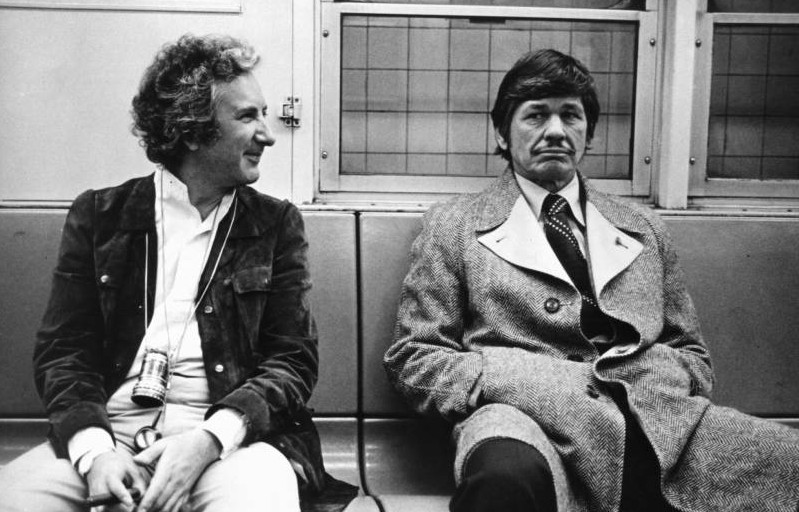
Michael Winner (left) and Death Wish star Charles Bronson
(source: cinemamuseum.org.uk)

Last month, the world lost Michael Winner to liver disease, and, although in recent years, he has become synonymous with his catch-phrase “Calm down, dear!” I have decided to take a look at his incredible life.

Robert Michael Winner was born an only child on the 30th October 1935 to George and Helen Winner; throughout his childhood he felt neglected by his parents, who wheeled him out to say hello to dinner guests. However, from this unhappiness Michael developed an infatuation with the famous and glamorous Hollywood A-listers and from age 14 was approaching them for his newspaper column “Michael Winner's Showbiz Gossip”.

In the 1950s, Winner began work at the BBC as an assistant director and soon began writing his own films. His early works were usually satirical comedies, one of which (Hannibal Brooks) gained Winner interest from America and also spawned his 25 year partnership with actor Oliver Reed. Another fruitful partnership of Winner’s was his work with the American actor Charles Bronson, whom he directed in early films such as Chato’s Land and The Mechanic.

Winner’s most notorious pieces of work came from his collaboration with Bronson, namely the Death Wish film series, with all five films together making $62,808,612 at the box office, which at the time was a much more impressive figure than it seems. The Death Wish series was based on the novel by Brian Garfield, a crime thriller centred around a man who becomes a vigilante after the death of his family. The first film in the series generated much controversy among film-goers, however it was commercially successful: one of 1974's highest-grossing movies. Following the success of the first Death Wish movie, Winner attempted to branch out into other genres, however he found that this very success had pigeon-holed him as an action director and his other efforts did not meet with such box-office acclaim. However, perhaps he should have been more selective with the films he helmed as Won Ton Ton, the Dog Who Saved Hollywood was arguably never going to be a smash hit.

In the early 1980s, following his run of flops, Winner needed a commercially successful film and so teamed up with Bronson again to produce Death Wish II, which, despite receiving criticism for being just a more violent version of the first film, still made $16,100,000 at the box office. Following this release, Winner repeated himself again and started producing flops; with his popularity and credibility on the slide, he decided to go out with a bang and released Death Wish III. Following this, Winner decided to focus on directing smaller British films including Bullseye with Michael Caine and Roger Moore and Parting Shots.

Following his retirement from the film industry, Winner put his outspoken mind toward critiquing food and started a newspaper column called “Winner’s Dinners”; he was very enthusiastic in his food, once quoted as saying “success has gone to my stomach”. However perhaps he was too enthusiastic as, on 1st January 2007, Winner acquired bacterial infection from eating an oyster in Barbados. He almost had a leg amputated and verged on the brink of death several times; in retrospect, Winner regarded his decision to eat it as "stupid".


Despite his successful career, Winner’s personal life did have its tribulations. After his father’s death in 1975, his mother developed a serious gambling addiction to the extent that Michael recalled seeing marks in the paint in his house where beautiful paintings had been sold to pay for her addiction. Despite her gambling away Michael’s £10 million inheritance, he always forgave her and urged her to get help with what he saw as an illness. Winner married Geraldine Lytton-Edwards and was typically candid about their engagement, saying “I'm not sure when we will get married. I acquired a fiancĂ©. I said, "Geraldine, darling, it's taken me 71 years to get a fiancĂ© - so don't hold your breath for the wedding!" However, despite this, they did finally tie the knot on 19th September, 2011.

Michael Winner died aged 77 on the 21st January, 2013. Britain lost a national treasure and cinema lost a legend. 
Read More
Posted in Blog Exclusive, Film and Drama | No comments

Monday, February 11, 2013

Y.O.L.O. – A Social Death Sentence

Posted on 11:18 PM by Unknown
by Tom Harper


"You Only Live Once" - A phrase drunken teenagers and morally-warped thrill seekers use to signal that they're about to make a bad decision. Ever since the hip-hop artist Drake astutely observed that "You only live once, that's the motto n***a Y.O.L.O." this particular abbreviation has become popular due to numerous adolescents seeing it as an excuse to perform daring or otherwise reckless acts purely for the sake of their own mortality. Whilst this phrase is currently the M.F.T.M.A.T. (Most Frequently Trending Meaningless Acronym on Twitter), there are many faults to this abbreviation that have been painfully overlooked. Thus far it is my firm belief that if we had any sense at all we would outlaw this detrimental acronym for a few simple reasons:

1.      It encourages a social regression in intelligence.

The first and foremost reason for my vendetta against such a phrase is its instigation of a mass reduction in linguistic flexibility, as frankly if society needed a lobotomy this would be the slow but effective way of doing it. My primary hatred of Y.O.L.O. stems not necessarily from what it entails in the short term but in the long term, as its abbreviation denotes a vocal laziness that could accentuate in the future due to its current popularity.

Picture it: a society that uses letters to represent their feelings or actions rather than expressing them through the beauty of language. Instead of asking “Is the Bus Running Late Today?” one would say “I.B.R.L.T.?”. Rather than study the poetry of geniuses such as Frost and Browning, schools would forcefully deteriorate F. Scott Fitzgerald’s finest piece into “T.G.G.”. In place of more traditional methods of courting, asking someone out would simply require the phrase “W.2.G.O.A.D8?” (Want to Go On A Date?). It may just be me, but a future that is so reduced in its ability to speak is a primitive future not worth “Only Living Once” for.

2.      The phrase is untrue when considered in alternate contexts.

As well as the grammatical inferiority of this phrase annoying me, it should be taken into account that this acronym is also wrong in terms of some situations bringing with them exceptions. Thus not only does this abbreviation reveal a lack of competence but also of general knowledge.

For example:

·   Buddhists believe in the act of reincarnation, and so this phrase could be seen to go against their religion in terms of its implications of mortality.
·   The hit Bond Film You Only Live Twice proves that in a more cultured atmosphere the singularity of life can be defied, especially when the person is someone as Godly a Sean Connery.
·   If we are to accept the power of phrases, then surely cats having ‘nine lives’ gives such sayings a paradoxical quality.
·   Doctor Who is set to have 13 incarnations of himself. Granted, this may only be a television programme but the acronym would nonetheless render itself useless within one of the only abbreviations I deem acceptable: The TARDIS.


3.      It is practically guaranteed to decrease life expectancy.

By using the phrase Y.O.L.O. in any situation, a person is almost automatically agreeing to risk their health and/or very life for the sake of perhaps never having the opportunity to do it again. However, what the majority of youths seem to misunderstand is that by performing such acts they are ensuring whatever single life they are living is drastically shortened if not terminated altogether.

Surely the purpose of exclaiming “Y.O.L.O.” and then drinking yourself under the table is to make a proclamation to your fellow binge-drinkers that life is short, and so must be pushed to its limit in every situation. Yet by doing so you are ensuring the validity of such an abbreviation by risking the very life you wish to enjoy. Hence Y.O.L.O. in such situations is the verbal acceptance of a mortal contract, denoting that you agree to potentially end your life through trying to renew it!

4.      It makes the brevity of life a much harsher reality.

Conversely, such a phrase could be seen to extend one’s life expectancy through reminding oneself that death lurks around every corner, thus causing one to take obsessive precautions that would prevent enjoyment of the finer things in life. “You Only Live Once” is therefore also a brutal warning that arguably stops some from taking a risk once in a while that may be worth taking to get the most out of life. Despite the odd and partially demented lyrics to the Lonely Island’s new smash hit “YOLO” (featuring Adam Levine and Kendrick Lamar) (see above), its message is an interesting one and shows us that some can take this phrase too seriously and hence become paranoid of life’s many dangers that we all must face day to day.
Read More
Posted in Blog Exclusive, Personal | No comments

The Genius of Alfred Hitchcock

Posted on 1:10 AM by Unknown
by Louisa Stark

Alfred Hitchcock
(source: listal.com)
He may have been dead for over thirty years, but Alfred Hitchcock’s power to generate an audience still remains true for today.  Despite often making cameo appearances at some point during his own films, it is this year that really sees the director is being brought out from behind the scenes and transformed into a character himself.
During Christmas we had the television film The Girl, a dramatization of his supposed fixation with leading lady Tippi Hedren, and this week, with the release of Hitchcock, it would seem the renewed interest in one of the greatest directors of the twentieth century shows no signs of waning.  Although he was undoubtedly an eccentric, other aspects of his character are less certain, ranging from consummate professional to obsessive misogynist.Reports of Alfred Hitchcock still leave us questioning: "Who was the man behind the movies?"   
Yet, up until a certain point, I am not interested. When the movies are so good, the need to understand the fascinating and, arguably, disturbed persona ‘hiding in the corner with a camera’ seems unnecessary. On screen, the many layers of his films unfold, sometimes to reveal an insight into his mind, whilst at the same time leaving him shrouded in mystery, simultaneously mesmerising, chilling and beautiful. In other words, a genius.
These are (just a few of) my favourites:

Kim Novak in Vertigo
(source: towardsafuturetome.blogspot.com)
1.       Vertigo – Recently voted best film in Sight & Sound magazine’s annual poll.  An almost absurdly complicated plot is transformed into a haunting tale of obsession and paranoia, with Bernard Herrmann’s score used to devastatingly beautiful effect in the neon green scene d’amour.  


GraceKelly and Cary Grant in To Catch A Thief
(source: 4bp.blogspot.com)
  2.       To Catch a Thief – Although not one of his most famous or suspenseful movies, the plot is really secondary to the scenario: Cary Grant, Grace Kelly, the French Riviera – need I say more? 


James Stewart in Rear Window
(source: jonathanrosenbaum.com)
3.       Rear Window – A seemingly restrictive premise, revolving around the observations of a wheelchair- bound James Stewart from his back window, creates startling amounts of tension.  However, some light relief is provided from the gradual suspense by Grace Kelly modelling an array of Edith Head’s most elegant costumes.   


Vivien Leigh and Judith Anderson in Rebecca
(source: slywit.wordpress.com)
4.       Rebecca – The first film that Hitchcock made in America and, in my opinion, a pretty good start to his career that side of the pond. Naturally, it cannot surpass Daphne du Maurier’s novel, but the black and white eerie elegance of Mandalay makes the film worth seeing in its own right.  For me, Judith Anderson’s portrayal of Mrs Danvers is indistinguishable from the description of her character in the novel. 
 

5. North by Northwest --- in this fantasy thriller, Cary Grant is drawn into a world of espionage through mistaken identity, while the audience follows into one of intrigue and intense colour; this is one of Hitchcock's most entertaining and visually most striking movies. 

Read More
Posted in Blog Exclusive, Film and Drama | No comments

Sunday, February 10, 2013

Approaching Death in 'The Bell Jar'

Posted on 11:13 PM by Unknown
by Fay Davies


First edition of The Bell Jar, published in 1963
under Sylvia Plath's pseudonym, Victoria Lucas.
(source: thefullwiki.org)

The Bell Jar is Sylvia Plath’s only novel. It is told from the perspective of one Esther Greenwood and it details her depression, attempted suicide and slow recovery. Plath herself committed suicide 50 years ago today, but I will avoid the temptation to demonstrate the countless parallels the book has with her life. Instead, I want to look at the novel itself and explore the ways that the suicide is foreshadowed; the way that the seeds of death are sown from the outset.
The opening sets a particularly macabre tone: ‘it was a queer, sultry summer, the summer they electrocuted the Rosenbergs, and I didn’t know what I was doing in New York’. Esther looks back to a particular time in her life and it is clear that she associates this time with death. The startling revelation is dropped casually into the middle of the sentence, revealing something about the narrator’s mind, about the things with which she was preoccupied. ‘It had nothing to do with me, but I couldn’t help wondering what it would be like, being burned alive all along your nerves’. In the very first paragraph she puts herself quite graphically into the shoes of someone being killed. And the references to death do not end here. She goes on to recall ‘the first time I saw a cadaver’, and how it ‘floated up behind my eggs and bacon at breakfast’. Death is not distanced: it is present and it pervades the quotidian in what can only be described as a comical if disturbing image. It becomes, for Esther, an object of fascination. Whether the morbid focus here is a reflection of the narrator’s present outlook, her previous anxieties, or both, we do not know. Clearer, though, is a sense of foreboding; a sense that death may resurge as a vital theme.
The novel’s first sentence is interesting for another reason. It ends ‘…and I didn’t know what I was doing in New York’. Aside from the mention of execution, then, it introduces a feeling of disorientation which becomes crucial to Esther’s plight. She is an over-achiever; she has gained a place on a prestigious magazine internship and ‘was supposed to be having the time of my life’. Yet there is something wrong. ‘I just bumped from my hotel to work and to parties and from parties to my hotel... I couldn’t get myself to react’. Plath structures the early part of the novel in a way that reflects this stasis, these isolated happenings with no clear direction. It is grouped into chapters yet they seem to have very little pattern to them, and the distinctions between them are vague. Chapter Three, for example, begins with the recollection of a particular event, and then drifts backwards to an earlier event. It is not until some point in Chapter Four that we are back up to where we started, and all of this is punctuated by digressions into the more distant past. Esther recalls a banquet, perhaps, then a restaurant date, then a photoshoot. There are few clues as to where it is all leading and how it will end, except, perhaps, this analogy: ‘I saw my life branching out before me like the green fig-tree […] I saw myself sitting at the crotch of this fig-tree, starving to death, just because I couldn’t make up my mind which of the figs I would choose’. Esther has a lot going for her, yet is crippled by the variety of opportunity. The future is without shape and appears to hold just one certainty: ‘starving to death’.
Esther’s fear of the future is apparent also in her obsession with the various facets of coming of age. She puts great importance on the loss of virginity: ‘I saw the world divided into people who had slept with somebody and people who hadn’t’. She is wary of marriage: ‘So I began to think maybe it was true that when you were married and had children it was like being brainwashed’. She is very aware of what she has read in magazines about the various aspects of womanhood, and of what she has been told by her mother and the mother of her boyfriend. These figures represent the prevailing societal ideals of what a woman should be, and clearly Esther views these with ambivalence – even repulsion. An inability to reconcile herself with what she is ‘meant’ to be is a conceivable trigger for depression. A skiing incident which she recalls from her recent past encapsulates an impulse to reject the future and, instead, fly backwards. Despite her inexperience she hurls herself down a slope and breaks a leg; she remembers how she ‘hurtled on to the still, bright point at the end of it, the pebble at the bottom of the well, the white sweet baby cradled in its mother’s belly’. The final destination, death, is likened to being in the womb. It is the reversal of the forward momentum of maturity, and it is oddly comforting.
But maybe it is wrong to say that death is the only certainty. There is a light at the end of the tunnel, and it comes in the form of a writing course. ‘I was sure I’d find the letter of acceptance waiting on the mail table at home’. It is when she finds that she has been rejected from the course that she loses this ‘bright, safe, bridge over the dull gulf of summer’. The dark outcome suggested by the earlier fig-tree analogy becomes unavoidable: ‘I saw the years of my life spaced along a road in the form of telephone poles, threaded together by wires. I counted one, two, three… nineteen telephone poles, and then the wires dangled into space, and try as I would, I couldn’t see a single pole beyond the nineteenth’. Esther is unable to comprehend how life can continue. The future is non-existent.
Now the symptoms of depression truly begin. Now the novel is populated by doctors, by plans of suicide and by the attempt itself. But this should come as no surprise. From the beginning, Plath creates an atmosphere in which death seemed the norm: it invades the mind, the everyday. This is compounded by the way that growing older and choosing a path is made almost impossible. Esther says early in the story: ‘If neurotic is wanting two mutually exclusive things at one and the same time, then I’m neurotic as hell’. The emphasis on Esther’s indecision forms the basis for her despair. It soon becomes clear that death is going to happen, and I would argue that it happens because, in Esther’s mind, nothing else can.

Read Mark Richardson's Sylvia Plath: The Poetry's The Thing

Read More
Posted in Art and Literature, Blog Exclusive | No comments

Sylvia Plath: The Poetry’s The Thing

Posted on 4:10 PM by Unknown
by Mark Richardson

Fifty years ago, at around 11.00 in the morning of Monday 11th February 1963, a workman broke into a flat in Fitzroy Road in London. A nurse, who had expected to get into the flat at 9.00 in the morning, had been unable to get any answer, and she was so concerned that she persuaded him to break in. Her concerns proved very real indeed. The children were safe, but the kitchen had been sealed and the body of their mother, Mrs Hughes, lay beside the gas oven. It was a cold winter, and London was in the grip of icy conditions, so the death of a young mother, regrettable in itself, might not be expected to create much in the way of headlines. Only two years earlier, the act of attempting suicide had still been an offence, but that time had long gone, and here was, seemingly, just another addition to the grim statistics. However, that suicide in particular proved to be the birth of an entire literary industry, provoking numerous controversial biographies, deep distrust and anger amongst many friends, family members and commentators, together with innumerable letters, articles, newspaper reports, TV programmes, even a film starring Gwyneth Paltrow.

Why? Well, change her surname to her maiden name, Plath, and everything else changes too. From “just” a statistic, that death has become the defining moment in a life, the life and work of Sylvia Plath, American poet and novelist and, significantly as it turned out, wife of up and coming poet Ted Hughes (later Poet Laureate until his death in 1998).

Plath’s poetry has become entwined with that death. Her suicide has inevitably been connected with her poetry, and has become the way for many of labelling, even defining her poetry. When she writes in ‘Lady Lazarus’ that ‘dying /Is an art. / Like everything else / I do it exceptionally well’, what a gift that is to anyone wanting to “make sense” of her work. Here is someone dramatising her own earlier attempts at suicide, a hubristic moment that would later be horribly tested. With her suicide in mind, any earlier poem can then be immediately read as being by someone for whom the riddle of existence is connected with her ability to close her eyes, invoking the word ‘dead’, and thus stopping the world (in ‘Mad Girl’s Love Song’ she writes ‘I shut my eyes and all the world drops dead’).

But her poetry has also been promoted as evidence, as if it were needed, of the continuous and continued repression of women by men, and thus becomes essential material for courses that deal with the feminine voice. By only a decade after her death, Plath’s work was an expected element in modern literary studies in universities in both the US and the UK. With feminism forming a crucial part of the political and intellectual life of many in the 1970s, Plath’s poetry could readily be made centre stage, her death symbolising both the battleground and the principles for social change.

But for me, with fifty years having passed, it is the poetry that should shine through. It is the poetry, not her gender or her mental turmoil, that should be central to its own meaning. I adore her drama, her courage, her passion, and indeed the ‘masculine’ qualities of her voice, where her spirit and energy are demonstrated on a page in phrases that might more readily be seen, perhaps still, as actions more commonly expected amongst male behaviour: confidence, assertiveness, arrogance, power. But I also adore her ability to produce combinations of words that are extraordinary in their own right. They are not valuable because they are written by a woman, or because they are vital clues to an individual’s mental state, but because of their inherent fire, their power to provide a frisson in a reader when read for the first, second or hundredth time. In ‘Lady Lazarus’ I choose to celebrate an earlier section to the previously-quoted familiar lines, being a much more disturbing and troubled quatrain:
 I am your opus,
I am your valuable,
The pure gold baby
That melts to a shriek.

I can’t quite pinion that effect of that quatrain in any comforting and definitive way: for me, it hints at William Blake, it is somehow reminiscent of the chants of the Witches in Macbeth, it is a charm that casts a spell. But it is moments like that, and concluding lines of her poem ‘Wuthering Heights’ when she describes looking down at a Yorkshire valley at night and describes it thus:

Now, in valleys narrow
And black as purses, the house lights
Gleam like small change.

So, you don’t have to be female, or a budding psychologist, to find the power of her work. It’s the poetry that’s the thing.

Read Fay Davies' Approaching Death in 'The Bell Jar'
Read More
Posted in Art and Literature, Blog Exclusive, From Teachers | No comments
Newer Posts Older Posts Home
Subscribe to: Posts (Atom)

Popular Posts

  • Recipe: Fifteens
     by Patrick McGuiggan The definitive Northern Ireland traybake is the ‘Fifteen’. They are so delicious I assumed that they would be fairly ...
  • Windows 8: Worth Your Money?
    by William Bates Windows 8 is the latest operation system (ie. Windows version) from Microsoft.   Installation of Windows 8 is quick and eas...
  • Review: Iron Man 3
    by Oli Price The Iron Legion (source: marvelcinematicunivese.wikia.com) It's taken me a while to write this review because I'm a b...
  • Is Conscience Innate or Learned?
    by Oliver Price (source: adorotedevote.blogspot.com) Developmental pyschologist Jean Piaget put forward the theory that conscience is learne...
  • Favourite Films: Skyfall
    by Tom Harper Upon my recent exploration of the latest movie archives I was stopped dead in my tracks by Disney and Pixar’s recent announcem...
  • Kick Racism Out Of Football!
    by William Hine England's Danny Rose reacts to racial abuse from Serbian fans, following his unjust sending off (source: Guardian ) In t...
  • What Do You Even Do In That Game?
    by Callum Cross That is the most asked question when you explain to someone that you play Pro Cycling Manager 2012 . As you may or may not k...
  • Review: Green Day - ¡Uno!
    by Tim Bustin (source: musictrajectory.com) Green Day is one of the few bands willing and able to constantly evolve and experiment with thei...
  • Why The Iraq War Was Wrong
    by Alex Quarrie-Jones Ten years after the beginning of the Iraq War (on March 19, 2003) and the subsequent ruination of the reputations of m...
  • Winner of PGS in Bloom: Administration
    by Will Hall  Herbs, wildflowers and thyme capsule

Categories

  • Art and Literature (72)
  • Blog Exclusive (466)
  • Creative Writing (36)
  • Current Affairs (55)
  • Economics (12)
  • Film and Drama (62)
  • Food (12)
  • From Parents (1)
  • From Teachers (54)
  • Hackers (12)
  • History (21)
  • Language (17)
  • MUN (1)
  • Music (58)
  • Personal (45)
  • Philosophy and Religion (20)
  • Photography (66)
  • Psychology (13)
  • Science and Tech (41)
  • Sport (58)
  • Travel (14)

Blog Archive

  • ▼  2013 (346)
    • ▼  September (21)
      • Hollister : A Short Play
      • Is Bale the Real Deal?
      • Mathematical Fallacies
      • RN/RAF Summer Camp 2013
      • Review: "I Wanna Be Yours"
      • The Swedish: T/S Gunilla
      • Seafront at Sunset
      • A Response To "Why Abortion Should Not Remain Legal"
      • Why Abortion Should Not Remain Legal
      • In Defence of Warhammer (40k)
      • You’re Not Too Cool For Summer School
      • A Warning To Voters Down Under...
      • My 5 Sports-People of the Summer
      • Squirrel in the Classroom
      • Poem: By The Sea: A War’s Tale
      • Photographs: 5 Summer Beaches
      • PGS at the International Theatre Festival, Avignon
      • Photography: The Belt of Venus
      • Favourite Album: 'OK Computer' by Radiohead
      • Photograph: On Milton Common III
      • Poem for Sunday: Pevensey Beach
    • ►  August (20)
    • ►  July (43)
    • ►  June (52)
    • ►  May (42)
    • ►  April (41)
    • ►  March (42)
    • ►  February (38)
    • ►  January (47)
  • ►  2012 (153)
    • ►  December (41)
    • ►  November (48)
    • ►  October (45)
    • ►  September (19)
Powered by Blogger.

About Me

Unknown
View my complete profile